Baby Nose Pierce India Girls Nose Pierce India
| Olfactory organ piercing | |
|---|---|
 | |
| Nicknames | Nostril, nose ring |
| Location | Nose (nostril, nasal septum, nose bridge) |
| Jewelry | olfactory organ stud, nose os, Circular barbell, curved barbell, captive dewdrop ring |
| Healing | six to ix months for nostril and bridge, 3 to v for septum |
Nose piercing is the piercing of the pare or cartilage which forms any role of the nose, normally for the purpose of wearing jewelry, called a nose-precious stone. Among the unlike varieties of nose piercings, the nostril piercing is the most common.
Nostril piercing [edit]

Early 20th century Indian nose ring
Nostril piercing is a torso piercing practice for the purpose of wearing jewelry, much like ear piercing, which is about primarily and prominently associated with Indian culture and fashion since classical times, and found usually in Republic of india, Islamic republic of pakistan, Bangladesh, Sri Lanka, Nepal, South and Southeast Asia, and Europe, specially Poland. Nostril piercing is likewise part of traditional Australian Aboriginal civilisation[1] and the culture of the Ilocano, a tribe in the Philippines.
Since the introduction and improvidence of Indian fashion and culture in the 1960s, punks and subsequent youth cultures of the 1980s and 1990s adopted nostril piercing. Today, nostril piercing is popular in the wider world including S America, U.s.a. of America, Canada, the Caribbean, Commonwealth of australia, Africa, Japan and Europe, with piercings beingness performed on either the left or right nostril. For some cultures, this practice is only for decoration, while for others it is for religious practices. Initially in America, this practise was for subcultures and was seen to be associated with minority youth.[ii]
In the Us, nose piercings may have negative connotations. For case, in a 2006 survey washed in the hospitality industry, 81% of hiring managers stated that piercings and tattoos touch on their perception of the candidate negatively.[3]
Historically in the Indian Subcontinent, nose piercings were done by women only.[ citation needed ] However the spread of this fashion has resulted in both men and women having nostril piercings in the wider world. Several unlike types of nostril rings are institute.
In India, the exterior of the left side of the nose[ commendation needed ] is the preferred position of the piercing. This is followed past some orthodox folk also considering Ayurvedic medicine associates this location with the female reproductive organs.[iv] In Bharat, like whatever other jewelry, piercings and the jewelry are regarded as a marker of beauty and social standing likewise equally a Hindu's honour to Parvati, the goddess of marriage. Olfactory organ piercing is all the same popular in India and the subcontinent. The piercings are often an integral office of Indian wedding jewelry. In Maharashtra, women wear very large intricate nose pieces that frequently cover the oral cavity or the side of the face.
This practice is very common amongst Bengali women and South Indian women.[ citation needed ] Tamil women traditionally pierce their right nostril.[ citation needed ] Numerous traditions are associated with information technology. Many women from the Indian subcontinent are cremated with just their olfactory organ studs every bit jewelry is removed before the funeral. Indian widows normally remove their nose studs equally a sign of respect. Nose piercing has historically been strictly forbidden among many families of Kashmiris belonging to the Butt, Dar, Lone and Mir castes settled in Pakistan, as their ancestors associated olfactory organ piercing with people of menial descent in ancient Kashmiri society.[ citation needed ]
Nose piercing can be dated through pre-Columbian and colonial times throughout North and South America. Numerous condition ceremonies are carved into the North Temple of the Bully Ballcourt at Chichin Itza.[v] One of these processions is a olfactory organ piercing ceremony that is depicted on the North Temple vault.[5] Rather than depicting sacrifice, the common theme of the temple's carvings, the key figure is shown aiming what near probable is a bone awl to pierce the figure's nose.[v] The ritual of the nostril piercing signified the elevated status of this figure. His place in society is symbolized past his nose piercing. Similarly, nose piercing signified elevated status in Colonial Highland Maya. The two prominent lords, Ajpop and the Ajpop K'ama, of the Yard'iche were pierced through the olfactory organ at the acme of an elaborate anniversary.[5] Similar to a crowning of a king, the nose piercing was to show their newfound leadership of the K'iche.
In Yucatan, explorers Oviedo y Valdes, Herrera y Tordesillas, Diego de Landa, and Jeronimo de Aguilar all noted different olfactory organ piercings that they observed in Mayans and other cultures in Yucatan in general.[five] They reported that different stones could take different meaning within each civilization. In addition, they believed the unlike placement and size and shape of beads could announce the specific guild the person came from. The Toltecs were believed to have piercings through the ala of the olfactory organ that was adorned with a bead. While the Mayans pierced through the septum and consisted of an oblong dewdrop rather than a spherical.[5]
Septum piercing [edit]
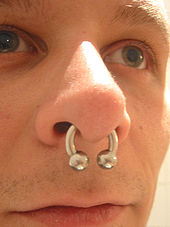
Large-gauge septum piercing
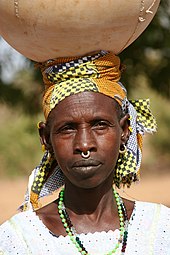
Fulani adult female with traditional nose ring and rima oris tattoo
The nasal septum is the cartilaginous dividing wall betwixt the nostrils. Generally, the cartilage itself is not pierced, but rather the small gap between the cartilage and the bottom of the olfactory organ (sometimes called the "sugariness spot" by piercers), typically at 14ga (1.half dozen mm) although it is often stretched to a larger gauge (size). This piercing heals within a month and a one-half to three months also depending on the individual. Information technology should only be stretched past 1mm at a time, and waiting at least a month between stretches is appropriate.[ citation needed ] If a certain betoken is exceeded, commonly about 8mm, the cartilage gets forced towards the elevation of the nose, which can be uncomfortable.
Many types of jewelry mostly are worn in a septum piercing, such equally: Captive bead rings (CBRs), rings that close with a bead held in the heart by the tension of the ring, round barbells (as shown in the picture), a round bar with a bead that screws onto either end, a "tusk" that is a straight or shaped piece of textile generally tapered on either finish, or pinchers. For large approximate septums, many individuals choose to article of clothing plugs, as the plugs practise non weigh their noses downward, which is helpful in healing. This measure out allows the piercing not to be damaged by the sudden motion of the jewelry.
Another choice is a septum retainer, which is staple-shaped. This type of nose piercing is especially easy to hide when desired, for example to comply with a dress code. A septum retainer makes possible turning the jewelry upwardly into the olfactory organ, thus concealing it. With black jewelry flipped upwards into the nostrils, this piercing tin can exist made practically invisible. A circular barbell can also be hidden past pushing it to the back into the nose, but information technology may be uncomfortable.
Septum piercing is a pop trend amid South Indian dancers (Kuchipudi, Bharatnatyam) and among certain Native American peoples in history; the Shawnee leaders Tecumseh and Tenskwatawa, for case, had such piercings.[ citation needed ]
The septum piercing is popular in countrysides of India, Nepal, and People's republic of bangladesh. In India such piercing is called the 'Nathori' and pop with the Banjara ethnic groups and Adivasi tribes. Lord Krishna and his consort Radharani are often depicted wearing the 'Nathori' mode precious stone nose pieces.[vi]
Bengali women traditionally would wear the nathori as a sign of being a married adult female. The nathori would be gold with a tear drop that would motility along the ring. Many lower-form women in rural Bengal all the same go along this tradition. This practice is now declining equally many women prefer the nose studs.
In southern Nepal the septum piercing is still common. Many older women yet adorn their noses with both the septum and left nostril rings. Many women have gold nose piercings to prove their social, tribal, and religious condition in society.
In Central Australia, nose piercing was cardinal to the development of a boy to a human. The Arunta, an aboriginal tribe in Primal Commonwealth of australia, rite of passage for a male child. The rite of passage began with dancing ceremonies and developed into the boy moving to the men'southward camp and learning to hunt.[vii] The boys are usually between the ages of 11 and xiii.[7] The women at first throw the male child into the air and then is handed the men to throw him into the air to symbolize the boy belonging to the men from then on afterwards.[vii] The male child learns to hunt larger animals that requires a tactful skill set up that was not needed for smaller game. After some time, the boy's nasal septum was pierced and inserted with a bone past his male parent or grandad to flatten his nose according to aesthetics.[7]
Likewise, girls' symbol of coming of historic period was a nose piercing, simply was done by her hubby afterwards marriage.[7] Culturally, the piercings signified the social condition of the private and their right to admission other ceremonies. For women, information technology displayed their ability to acquire a husband. For the married man, it displayed his ownership and right to his married woman. For men, information technology presented the boy now as a man and his place is society with men. He no longer belonged to the children and the women who raised him. In addition, he at present had the right to ceremonies such equally circumcision, subincision and an elevated position in society.[7]
Risks [edit]
The septum or nasal septum is the cartilaginous wall that divides the two nostrils. The cartilage is, however, usually not pierced. It is the thin strip of very soft and flexible pare, just between the cartilage and the bottom of the nose, where septum piercing is mostly done. Piercing the pare instead of the cartilage can profoundly minimize the pain, as well as other discomforts associated with this type of body piercing. This piercing should be done just with a needle. As far every bit jewelry is concerned, convict bead rings, circular barbells, plugs, tusks, curls, and septum retainers can be used. Some metals used in nose rings are safe, merely may cause allergies or sensitivity. Risk of bacterial infection is also nowadays in swimming pools, bodies of water and baths.[ citation needed ]
All types of trunk piercings, including septum piercing, are associated with the risk of contracting certain claret borne diseases, like hepatitis, from the needles and piercing guns used in the procedure. This risk can be reduced by getting the piercing washed past a reputed piercer and making sure that the piercer uses only sterile single-use needles. The next common adventure associated with almost all types of piercing is the risk of infection and pain. These bug can be minimized profoundly if piercing is washed on the soft and flexible skin that lies between the cartilage and bottom of the nose. As far as infection risks are concerned, they tin be managed with proper piercing aftercare.
This piercing can sometimes lead to 'septal hematoma ' -- an injury to the soft tissue within the septum that can disrupt the blood vessels to crusade the accumulation of blood and fluid under the lining. Nasal septum hematoma can eventually crusade nasal congestion and interfere with breathing along with causing pain and inflammation. If not treated immediately, the condition tin can ultimately cause formation of a hole in the septum, leading to nasal congestion. Sometimes, that part of the nose may collapse, resulting in a cosmetic deformity, known as 'saddle nose'.[ citation needed ]
Bridge piercing [edit]
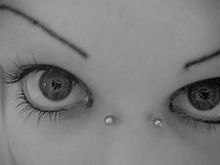
Bridge piercings are inserted through the pare at the top of the nose, between the eyes. Curved barbells and straight barbells are the most commonly used in this piercing, while seamless and captive rings are non recommended. Getting a span piercing done is somewhat riskier than other nose piercings. Like other surface piercings, the jewelry may migrate or cause scarring if not taken care of correctly. Span piercings require very specific anatomy, careful maintenance, and oftentimes many jewelry changes. A bridge piercing is pierced through the loose skin at the span of the nose. It is oft pierced with a 14 estimate needle, depending on the preference of the piercer and the client'south anatomy.[ citation needed ]
See as well [edit]
- Torso piercing
- Olfactory organ-jewel
- Olfactory organ ring (animals)
Notes [edit]
- ^ (Stirn 2003)
- ^ Martinez, Ramiro (July 2006). Immigration and Criminal offence: Ethnicity, Race, and Violence. ISBN9780814796054 . Retrieved half dozen/1/2019.
- ^ Swanger, Nancy (2006-03-01). "Visible body modification (VBM): bear witness from human being resource managers and recruiters and the effects on employment". International Journal of Hospitality Management. 25 (1): 154–158. doi:ten.1016/j.ijhm.2004.12.004. ISSN 0278-4319.
- ^ Morris, Desmond (2004). "The Nose". The Naked Woman. p. 69. ISBN9780099453581.
- ^ a b c d e f Villela, Khristaan, Verfasser (1993). A nose piercing ceremony in the northward temple of Great Ballcourt at Chichén Itzá. Center of the History and Art of Ancient American Civilisation of the Art Dep. of the Univ. of Texas. OCLC 1073558164. CS1 maint: multiple names: authors listing (link)
- ^ "Septum Piercing Dangers". Retrieved 17 Nov 2012.
- ^ a b c d e f Rush, John A. (2005). Spiritual tattoo : a cultural history of tattooing, piercing, scarification, branding, and implants . Frog. ISBN1583941177. OCLC 56876792.
References [edit]
- Stirn, A. (2003). Body Piercing: Medical Consequences and Psychological Motivations. The Lancet 361: 1205–1215.
Source: https://en.wikipedia.org/wiki/Nose_piercing

Post a Comment for "Baby Nose Pierce India Girls Nose Pierce India"