Get in My Car Well Keep Driving Till You Feel Warm Again
How driverless cars will change our world
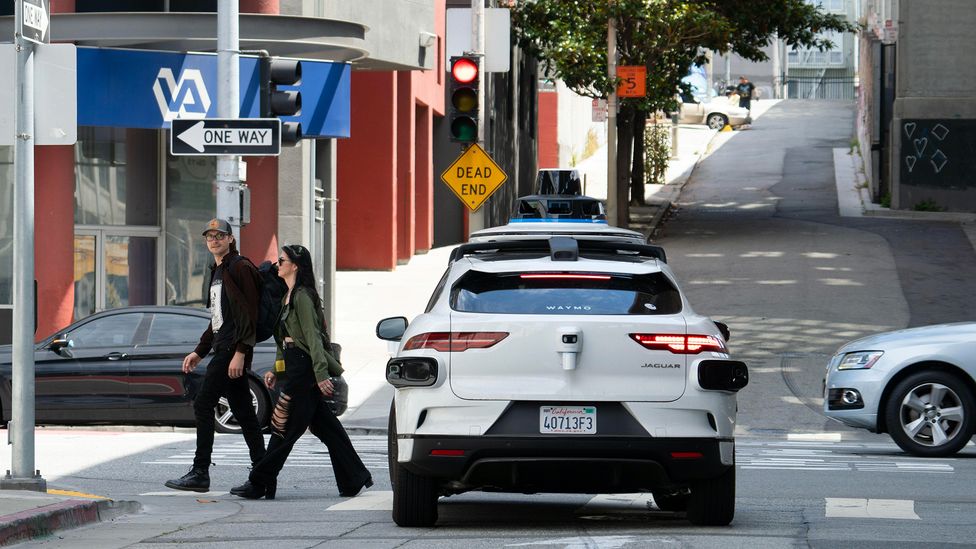
Self-driving vehicles are steadily condign a reality despite the many hurdles even so to be overcome – and they could modify our globe in some unexpected ways.
I
Information technology'due south a tardily night in the Metro area of Phoenix, Arizona. Under the artificial glare of street lamps, a car tin exist seen slowly approaching. Active sensors on the vehicle radiate a low hum. A green and blue 'W' glows from the windscreen, giving off just enough light to encounter inside – to a completely empty driver seat.
The wheel navigates the curb steadily, parking equally an arrival notification pings on the telephone of the person waiting for it. When they open the door to climb within, a voice greets them over the vehicle's sound organization. "Good evening, this motorcar is all yours – with no one upfront," information technology says.
This is a Waymo 1 robotaxi, hailed just ten minutes ago using an app. The open up utilise of this service to the public, slowly expanding across the US, is 1 of the many developments signalling that driverless technology is truly becoming a part of our lives.
The hope of driverless technology has long been enticing. It has the potential to transform our experience of commuting and long journeys, take people out of loftier-take a chance working environments and streamline our industries. It's central to helping the states build the cities of the future, where our reliance and relationship with cars are redefined – lowering carbon emissions and paving the way for more sustainable ways of living. And information technology could brand our travel safer. The Earth Health Organization estimates that more than i.three 1000000 people die each year as a outcome of road traffic crashes. "We desire safer roads and less fatalities. Automation ultimately could provide that," says Camilla Fowler, caput of automatic transport for the UK'south Ship Inquiry Laboratory (TRL).
Just in order for driverless applied science to become mainstream, much notwithstanding needs to change.
"Driverless vehicles should exist a very at-home and serene mode of getting from A to B. But not every homo driver around it volition be behaving in that manner," says David Hynd, master scientist for safe and investigations at TRL. "It'south got to exist able to cope with man drivers speeding, for example, or breaking the rules of the road."
And that's not the but challenge. There's regulation, rethinking the highway code, public perception, improving the infrastructure of our streets, towns, cities, and the large question of ultimate liability for road accidents. "The whole insurance industry is looking into how they're going to deal with that alter from a person being responsible and in charge to the vehicle doing that," says Richard Jinks, vice president of commercial at Oxfordshire-based driverless vehicle software company Oxbotica, which has been testing its technology in cars and delivery vehicles at several locations across the UK and Europe.
The ultimate vision experts are working towards is of completely driverless vehicles, both within manufacture, wider transport networks, and personal-use cars, that can be deployed and used anywhere and everywhere around the world.
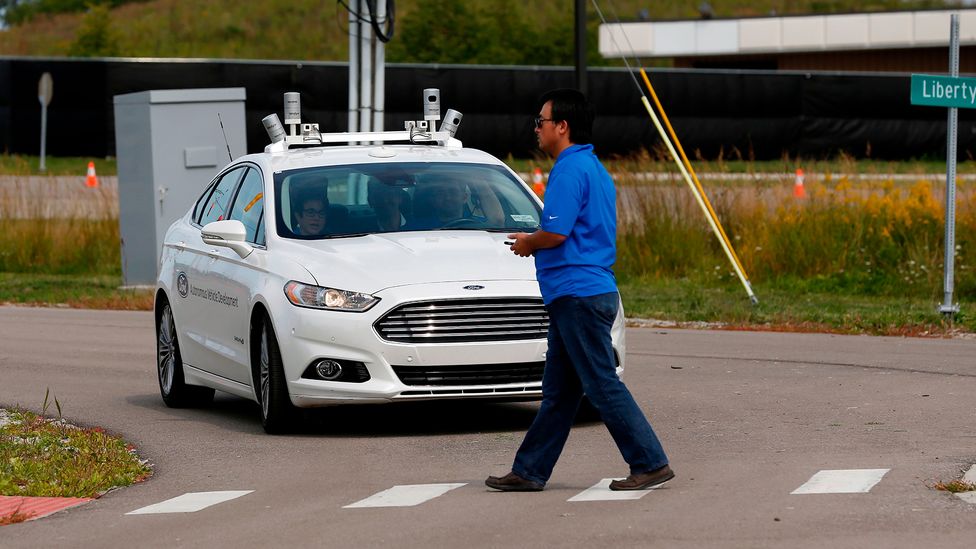
Mcity puts driverless cars through their paces in an surround that mimics a existent metropolis, consummate with crossing pedestrians (Credit: Jeff Kowalsky/AFP/Getty Images)
But with all these hurdles in place, what exactly does the next 10 years take in store for autonomous vehicles?
Two years from now
The biggest hurdle for those in the driverless engineering science industry is how to go the cars to operate safely and effectively in complex and unpredictable human environments. Bully this part of the puzzle will be the major focus of the next 2 years.
At the Mcity Test Facility at the University of Michigan, experts are addressing this. The world'southward commencement purpose-built testing ground for autonomous vehicles, information technology's a mini-boondocks of sorts, made up of sixteen acres of route and traffic infrastructure. It includes traffic signals and signs, underpasses, building facades, tree cover, dwelling house and garage exterior for testing delivery and ride-hailing, and different terrains such as road, pedestrian walkways, railway tracks, and road-markings which the vehicles must navigate. It'south here that experts exam scenarios that even the most experienced of drivers may be pressed to handle, from children playing in the street to two cars trying to merge on a junction at the aforementioned fourth dimension.
Change Agents
We know the globe has to change for humanity to thrive. But what are the about promising solutions that could provide the kind of transformation nosotros demand? In a world adjusting to the recent global pandemic, Change Agents examines innovations and technologies that could make our planet a meliorate, healthier identify to live.
"In order to test driverless engineering science similar this, it depends on hundreds of different variables in any given situation," explains Necmiye Ozay, associate professor of electrical and reckoner engineering science at the University of Michigan. Her solution is to create a group of varied thinkers.
"We're trying to bring people from unlike parts of the university – not only engineers, but nosotros have people from across disciplines such every bit psychology, more than human-machine-interaction type people, because in that location are lots of angles to this problem nosotros are trying to solve when information technology comes to safety," says Ozay. In the facility, Ozay and her team tin can test unlike traffic scenarios, as well as explore how autonomous vehicles communicate with each other however proceed vehicle and personal information secure from hackers.
That self-driving taxis are already on the roads in Phoenix, Arizona, is due to a prolonged testing process like the i Ozay's squad is conducting. Currently just bachelor as a test service to the public in small defined areas, in the next ii years at that place are plans to release the taxis on a greater and wider calibration. For example, Usa-based visitor Waymo is currently rolling out to new city examination sites that could very realistically see robotaxis operational in San Francisco and New York by 2023. Just their co-chief executive Tekedra Mawakana was cautious to say what further roll out of its service there might be, and where, because "safety takes fourth dimension".
AutoX, a start-up funded past Alibaba, launched its fully driverless RoboTaxi in Shanghai, Mainland china in 2020. By 2023 information technology's likely their service will be available in other cities across China, too as in California.
Much of the driverless technology already in use exists in industrial settings similar mines, warehouses, and ports, but Hynd believes in the next ii years we tin expect to see this extended to "last mile commitment". This means the last part of a journey for appurtenances and services – the betoken at which they are delivered to the consumer. For instance, autonomous HGV trucks on motorways or fifty-fifty delivery vehicles for products and groceries.
Five years from now
While Apple tree says it is aiming to launch fully self-driving electric cars four years from now, industry experts are more than cautious about what the near-future holds.
Co-ordinate to Fowler, the chat around regulation and insurance companies' new role within this ship space needs to mature. "Information technology'due south got to be a very iterative approach where nosotros're starting with pods and shuttles, or nosotros're starting with off-highway vehicles where you tin see such a benefit, and you lot've got a more than controlled environment potentially, and what works with that," she says. "Then we can scale information technology up and beyond more than vehicle types, more than employ cases."
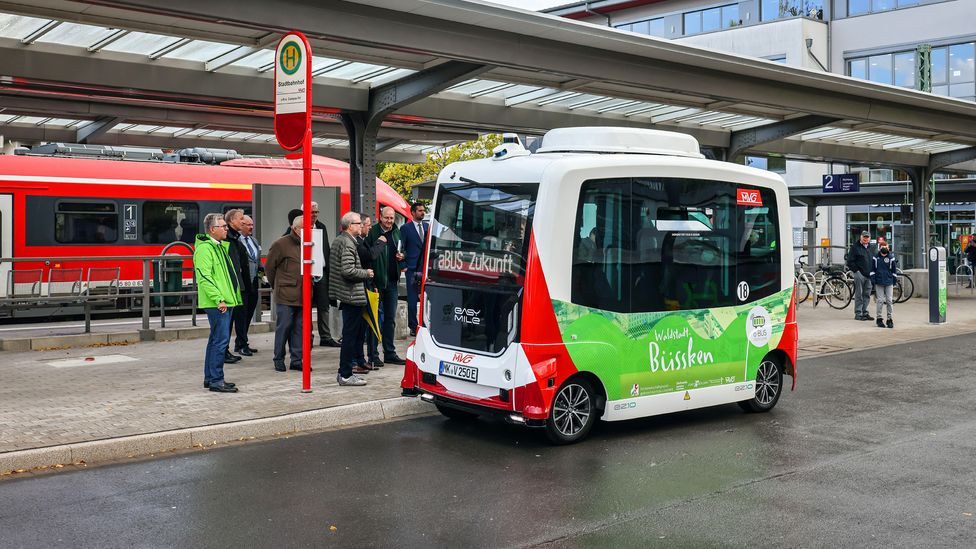
Democratic shuttles, such as these in Iserlohn, Germany, could help to link passengers on public send to other parts of a city (Credit: Alamy)
Ane new space we can await to see driverless applied science deployed in is high-risk environments, from nuclear plants to military machine settings, to limit the dangers to man life, says Fowler. A Rio Tinto mine in Western Australia, for example, is currently operating the largest autonomous fleet in the world. The trucks are controlled by a centralised system miles away in Perth.
"If you can take people out of that and you lot can have vehicles that are driving themselves, and are fully automated even, if you've got somebody who's remotely needing to control that vehicle in that loftier-chance surround then that's got to be good," says Fowler.
In the next 5 years most driverless technology will remain behind the scenes. TRL is investigating the potential for driverless HGVs on motorways, including the idea of platooning vehicles. Platoons are a grouping of semi-autonomous vehicles that bulldoze a close distance betwixt each other, stopping other vehicles from separating them. By driving closer together, vehicles in a platoon tin be more fuel efficient past taking reward of the slipstream of the truck in forepart while also helping to reduce congestion as the lorries take up less overall space on the road. Also in this space is Plus, the showtime self-driving truck manufacturer, whose European pilots commenced this year afterwards a successful trial on Wufengshan highway in China's Yangtze Delta economical middle.
You might as well similar:
- The cyberspace behemoth you lot've never heard of
- The engineering science to end traffic jams
- How Google's balloons surprised their creators
Away from these industries, Ozay further predicts that "we volition perhaps see lighter robotic vehicles that can potentially apply sidewalks and bike paths with express speeds – for delivering things such as food and groceries."
When it comes to public transport, Oxbotica is too working with German-based vehicle systems specialist ZF over the adjacent five years to brand the driverless shuttle a truthful mainstay for European cities, operating on roads, every bit well as at airports, much in the same fashion buses do now. "The shuttles in airports we see today on rails won't demand those rails in v years from at present. This means driverless shuttles have the potential to transport you from the machine park to the airport, then directly through to your gate and the plane," Jinks explains.
For users, this could mean more reliable and cost-efficient transport systems. "Interlinking autonomous ship systems to bring a public transport organisation that is as efficient as you jumping in your own car and driving it yourself has got to be the answer to congestion in the future," adds Jinks.
Vii years from now
All experts hold that the side by side seven years will depend on the successes and failures of initial deployments, and how safe and public trust evolves accordingly. However, most hope that city redesigns will enable more adoption of the technology and help move usa into modernistic, and more efficient ways of living. "If you lot live in a dense, urban area, the hope is that you'd be able to rely on mobility as a service. You could dial upward the auto, it would arrive in ii minutes, and you brand your journeying. Y'all wouldn't need to take those vast rows of parked cars in your street, which makes the street more navigable for the automatic vehicle," says Hynd.
Without parked cars lining the street, roads could be narrower, making style for more greenish spaces. But while proponents of self-driving vehicles insist they volition make our roads safer, at that place are some who experience pedestrians and autonomous vehicles simply can't mix. It could hateful that our cities and the mode we use them may need to be reimagined.
Some of this thinking is already taking place. In 2018, IKEA developed a concept autonomous vehicle that can double upwards equally coming together rooms, hotels, and stores. The touch this type of innovation would take is reduced requirement for travel in the starting time place, offer instead interchangeable, on-need environments every bit and when we need them. Our needs could exist met right where nosotros are.
Ozay expects many more than self-driving options to exist available for customers during this time, including in the passenger vehicle space. "My hope is that cars volition be smart enough to say 'yeah' or 'no' when asked if they can reliably and safely get a non-commuter from bespeak A to point B on a given day, by analysing the weather and traffic atmospheric condition beforehand," she explains.
ten years from now
Despite all the developments and innovations the next decade is likely to agree, some experts still feel nosotros might be a way off from total deployment of driverless vehicles. By 2031, "full-self driving – human-level or above, in all possible conditions, where you can put kids by themselves in the car to send them to arbitrary locations without worrying – is not something I wait to see," says Ozay.
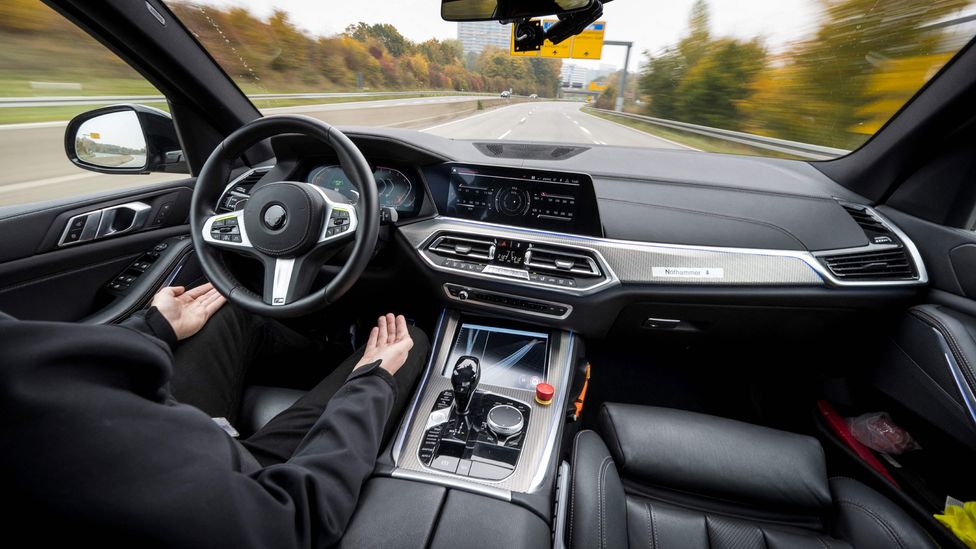
In one case commuters tin permit their cars have over the driving completely, will it free them upwardly for new kinds of productivity and activities? (Credit: Thomas Lohnes/AFP/Getty Images)
Hynd agrees that full automation is unlikely on this timescale. "With anything send infrastructure, anything that guild uses, so many other things demand to come up into play. And I don't just mean regulation," he says. Safety will be a major hurdle, especially for countries slower to prefer the alter because of the huge costs involved. Infrastructure will also dictate how fast and effectively this engineering tin can roll out, and public perception and willingness to use autonomous vehicles will demand to increment according to Hynd.
Merely not anybody agrees. Jinks is confident that nosotros'll see democratic vehicles on the roads at the same time as human-driven vehicles in ten years from now. In this vein, you may very well be stepping onto a driverless shuttle at the drome, and then into a cocky-driving taxi to accept yous to your last destination.
Owning a driverless car in the next 10 years is less likely – it'll however be likewise expensive for most people, according to Hynd. Only the hope of driverless technology is about unchaining us from our reliance on cars, and how that can transform the employ of our fourth dimension and our environment.
"This is one of the biggest technology problems that nosotros're trying to solve in a century," Jinks says. "It will be an evolution over time from less complex environments and capabilities, to more complex, to everywhere. It's a continuum, and recollect about that continuum... It will proceed improving over fourth dimension. These things will continuously learn from each other."
Much in the same style that electrical charging stations have slowly entered automobile parks, side streets, and service stations, and so too will democratic vehicles eventually make their fashion into our everyday worlds. Years from at present, we may well be wondering how we ever lived without them.
--
Join one million Future fans by liking united states on Facebook , or follow us on Twitter or Instagram .
If you liked this story, sign up for the weekly bbc.com features newsletter , chosen "The Essential List" – a handpicked selection of stories from BBC Future , Culture , Worklife , Travel and Reel delivered to your inbox every Friday.
Source: https://www.bbc.com/future/article/20211126-how-driverless-cars-will-change-our-world

Post a Comment for "Get in My Car Well Keep Driving Till You Feel Warm Again"